From Ocean Curiosity to Engineering Confidence: How Invention Convention Helped Shape Jack’s Path
For Jack Driscoll-Natale, the path to invention didn’t begin in a laboratory or classroom. It began along the coastline of Santa Cruz, California — where the Pacific Ocean meets redwood forests and the influence of Silicon Valley is never far away.
Growing up there meant living between two powerful forces: the natural environment and the rapid pace of technological innovation. Jack spent much of his time outdoors, exploring the water and forests that surrounded his community. At the same time, he was aware of the culture of innovation that flowed south from Silicon Valley.
That intersection shaped how he saw the world — and ultimately led him to his first invention.
“I loved being outside,” Jack recalled. “Surfing, being in the water, exploring the forest. But you’re also surrounded by technology and innovation. Seeing both of those things together made me start thinking about how technology could help protect the environment.”
That curiosity eventually led Jack to Invention Convention, where he began developing a project focused on a challenge affecting his coastal community: the lack of accessible public water quality data.
A Young Inventor Tackles a Real-World Problem
Researchers often rely on monitoring devices placed in rivers, lakes and oceans, Jack explained, but collecting the information requires physically retrieving data from those systems. Scientists must travel to remote locations to remove SD cards or replace batteries, limiting how quickly the data can be shared and analyzed.
“I wondered if the process could be more efficient — and more accessible,” Jack said.
His solution, H2O Monitoring for All, is a wireless, solar-powered water monitoring system designed to operate independently while automatically uploading environmental data. By combining solar energy with wireless technologies such as Wi-Fi and Bluetooth, the device can collect water data and transmit it directly to a website where researchers and the public can access it in real time.
As Jack sees it, the system removes the need for constant maintenance in the field while dramatically expanding access to environmental information.
Learning Through Collaboration
Turning the idea into a working invention required far more than technical curiosity. At the start of the project, Jack had little experience designing engineering systems. Rather than trying to solve every challenge alone, he began reaching out to people who understood different parts of the problem.
Some of those individuals were scientists who used monitoring systems every day. Others were engineers who helped design similar technologies. One of the first experts Jack contacted didn’t build monitoring devices at all — she simply used them in her research. That perspective proved invaluable. “She told me the problems she runs into every day,” Jack explained. “That helped me understand what actually needed to be improved.”
Those conversations shaped the direction of his project and reinforced an important lesson: Invention rarely happens in isolation. “If your invention is meant to help other people, you need to talk to those people,” Jack said. “Even simple conversations can change how you think about the problem.”
Confidence Through the Invention Process
What makes Jack’s story even more remarkable is that this project was his first true invention. While he had completed science fair projects before, invention required a different mindset — one focused on designing solutions rather than analyzing existing systems.
The process pushed him to learn new skills, experiment with prototypes and navigate challenges without a clear roadmap. Yet it was precisely that uncertainty that made the experience so powerful. “The biggest thing I gained from inventing was confidence,” Jack said. “It’s one thing to solve a homework problem. But seeing a problem in the world and building something new to address it — that’s incredibly empowering.”
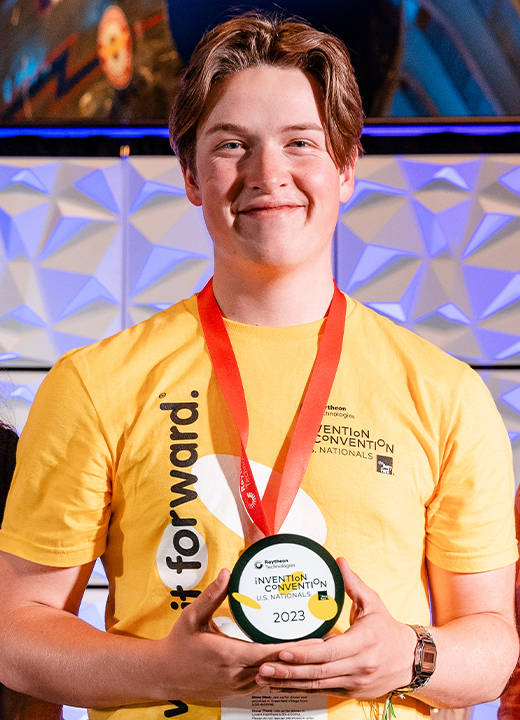
That confidence reached a new level when, in 2023, Jack advanced from the California Invention Convention State Finals to RTX Invention Convention U.S. Nationals, hosted at Henry Ford Museum of American Innovation. Jack ultimately took home two awards: a Patent Application Award, presented by WilmerHale and the Connectivity Award, presented by RTX. He was also invited to advance to Invention Convention Americas 2023, presented by RTX, where he earned third place in the 9th–11th grade category.
Standing on stage surrounded by fellow student inventors from across the country was an unforgettable moment. “It was amazing,” exclaimed Jack. “I felt like a rock star. But what I remember most is talking with the other inventors and hearing their stories. Everyone had taken a different path to get there.”
Skills That Continue to Shape His Future
The experience came at a pivotal moment in Jack’s life. As a high school junior preparing for college applications, the recognition reinforced his growing interest in engineering and problem-solving.
Today, Jack is a sophomore studying electrical engineering at the University of California, Santa Barbara. While his academic path continues to evolve, the lessons he learned through invention remain central to how he approaches challenges.
One of the most important is problem-solving — the ability to work toward a solution without a predefined set of instructions. Invention taught him how to define a goal, research possible approaches, and iterate through trial and error.
Equally important were the research skills he developed along the way. Learning how to find reliable information, evaluate sources and build on the knowledge of others have proven invaluable in university-level engineering work.
And perhaps most unexpectedly for him, invention strengthened his ability to communicate complex ideas. Presenting his project to judges, mentors and researchers helped him develop the confidence to explain technical concepts clearly — a skill that continues to serve him well today.
Giving Back to the Next Generation of Inventors
Even as he pursues his studies, Jack remains connected to the Invention Convention community. As an alumnus of the program, he now mentors younger students exploring engineering and invention projects of their own.
For him, supporting the next generation of inventors is one of the most meaningful ways to give back. “It feels like opening a door for someone,” he said. “You’re showing them an opportunity they might not have realized was there.”
When he speaks with students beginning their own invention journeys, Jack shares a piece of advice that reflects his own experience: Start with a problem you genuinely care about. Trying to invent something simply because it sounds impressive rarely leads to meaningful results, he believes. “Passion for the problem — the curiosity that makes you want to solve it — is what keeps us inventors moving forward through challenges.”
For Jack, that passion began with the ocean outside his hometown. Through Invention Convention, that curiosity grew into an invention, national recognition, and ultimately a pathway toward a career in engineering.
And for the students he now mentors, he hopes it becomes something even bigger: the moment they realize they have the power to solve problems that matter